Three years of one invented practice venture, followed from a first idea to a first closed year, through the hours ceiling of year two, and into the year-three question underneath all of it: what does the household actually own?

Most business courses teach a launch and stop. This one runs three consecutive years of the same small venture — a sewing bench in a garage — and keeps a ledger the whole way, so you watch a real cost structure form, harden, and then have to change. Nothing here recommends a business, an entity, a price, a hire, a loan or a sale. Those decisions route to you, a CPA or an attorney, and your state's filing office, and the course says so every time one comes up.
Straight out of the three books this track is built on, and every one of them is a thing you do on your own numbers.
Every title is the real title. Every line under it is what that lesson actually teaches, and every "do this" is the single action that lesson asks of you.
An idea is a guess. Evidence is a count of things that already happened.
An audience gives you words. A customer gives you money. Only one is a market.
Materials in one apron: $14.55 plus $3.15 plus $0.55 is $18.25.
The floor is what one finished thing costs you, all in. Here it is $36.80.
The $45.00 table fee was spent on Thursday, so the day started at minus $45.00.
In $483.00, out $222.75, so the tin holds $260.25. That is cash, and it is true.
Meeting a stranger costs money; here it was $22.50 per buyer.
$414.00 was agreed on day 0 and $207.00 actually moved on day 0.
The bench started the month with $260.25 and took in $621.00 from nine aprons.
A sole proprietor is the default the moment money is earned — nothing is filed.
There is no national list; requirements vary by state, city and trade.
96 aprons at $69.00 brought in $6,624.00 across twelve months.
Year one sold 96 aprons and took 208.8 hours to do it.
Dana's $22.00 an hour is a costing choice, not pay she received.
Forty-eight measured minutes is really 18 of setup plus 30 of sewing.
The deep-pocket apron rides inside the same sitting and the same buyer.
The wholesale price was $7.80 a yard against $9.80, minimum one bolt.
The press costs $340.00 and takes six minutes off every apron.
Four aprons at a table leave $151.60 in these practice figures.
A miss caught at the bench costs about $2.34 in practice figures.
Three aprons sold, $207.00 in, and nothing had gone wrong.
At $69.00 a sale leaves $37.90 in these practice figures.
The account opened at $667.60 and closed at $917.60.
138 things sold, against 96 in the closed first year.
The bench owns $1,404.40 of things and owes $228.00.
Five figures from one closed year stood on 253 documents.
The policy: $250.00 on the first, a $600.00 floor.
Shapes are described here and never recommended.
The same $6,000.00 held the same 24 months, three ways.
A practice premium of $546.00 is $45.50 a month.
Writing the market-day page cost 2.5 hours, or $55.00 of her time.
The closed practice year put $4,519.66 through the bench's account.
Three endings exist: sell it, wind it down, keep it. There is no fourth.
The second year handed back 50.7 hours, worth $1,115.40 of her time.
Teaching one whole market day took 5.5 hours, or $121.00 of her time.
156 things and $11,964.00 in, against 96 and 138 in the years before.
The course teaches it simple: short lessons, a family handout for each, one action at a time. The books are the expanded edition of those handouts — the same material worked to the penny, three different ways, every chapter in one easy place. Own both for the full complement: watch it work here, read it deep on paper.

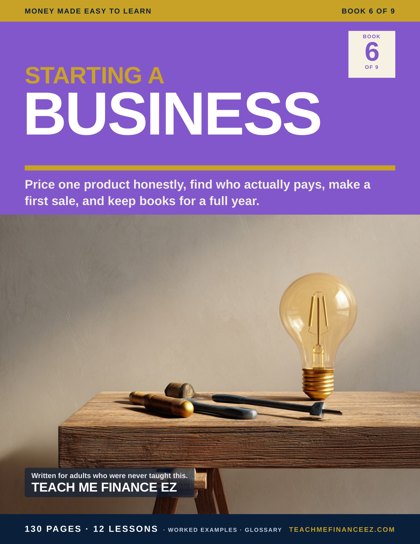
Price one product honestly, find who actually pays, make a first sale, and keep books for a full year.
Digital edition · $19Paperback on Amazon · $34.99
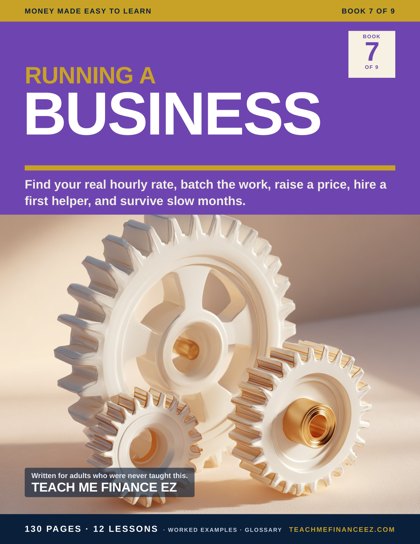
Find your real hourly rate, batch the work, raise a price, hire a first helper, and survive slow months.
Digital edition · $19Paperback on Amazon · $34.99
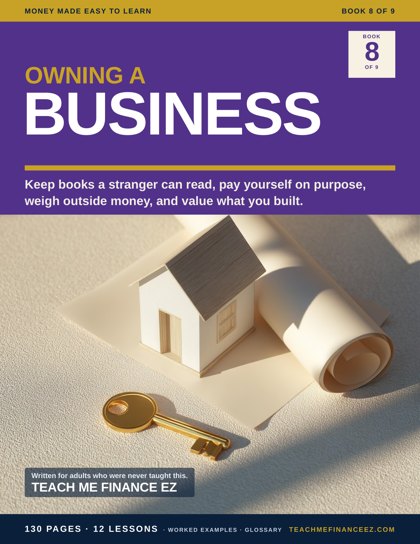
Keep books a stranger can read, pay yourself on purpose, weigh outside money, and value what you built.
Digital edition · $19Paperback on Amazon · $34.99So you always know where you are, and the depth never depends on how motivated you felt that day.
A short lesson that names the thing and shows you the shape of it. Lazy-loaded, so the page is not carrying it until you press play.
Five plain sentences, taken from that chapter's own summary, so you can tell in ten seconds whether you already have this one.
A single thing to do on your own numbers. Not a homework pile. One action, small enough that it actually happens.
That lesson's own PDF: the worked example, real blanks for your own numbers, and the one action. Print it, fill it in together, keep it on the fridge.
The exact chapter and page in the expanded book — sold separately — where this lesson is worked out in full, with the math, the three scales, and the six what-ifs.
Mark the lesson complete and the track remembers. Come back next week and it tells you where you stopped.
Every one of these is defined on the page it first appears on, in a sentence a person can actually use.
Three volumes, three years: start it, run it, own it. Every number worked in public. It is 36 video lessons, each with its own downloadable family handout — a real per-lesson PDF, enough to teach that lesson on its own. Each lesson pairs one video with one handout and one action small enough to actually do. The matching book — Starting a Business — is the expanded edition of those handouts and is sold separately.
Every lesson has its own handout PDF built from that lesson's walk-through: the worked example, the blanks you fill with your own numbers, and the one action. Sufficient on its own — and when you want the full depth, the book works the same material to the penny, in one place.
No — and that is on purpose. The course stands on its own: every lesson has its own family handout PDF, and the handouts are sufficient. The book is the expanded edition — the same material worked to the penny, every chapter in one place — sold separately here as a digital edition and on Amazon in paperback. Each lesson page points you to the exact chapter so the two fit together perfectly. Course plus book is the full complement; the Everything bundle is the one purchase that includes both.
No, and it never pretends to be. Everything here is general financial education. It is not financial advice, not tax advice, not investment advice and not a recommendation about your circumstances. Every dollar figure is an invented practice number for a made-up household — not a forecast, not typical of anything, and not a claim about what anyone earns. For decisions about your own money, a licensed professional who can see your actual paperwork is the right person.
Watch the video, read the chapter, do the one action. Most people give a lesson somewhere between twenty minutes and an hour depending on how much of the chapter they read in one sitting. There is no schedule, no cohort and no expiry — the track sits in your library and waits for you.
It is built in order and the story runs forward, so first time through, in order is easiest. Nothing stops you jumping — every lesson page carries its own family handout and its go-deeper chapter pointer, and your progress is tracked lesson by lesson so you can wander and still know what you have done.
Email us inside 30 days and you get all of it back. No form, no reason needed, and nobody will try to talk you out of it. You may keep the files — asking somebody to delete a PDF is theater.
Yes. The Everything bundle is every book and all seven tracks for $49.99 once, with free updates for life. If you only want this one track, buy this one track — that is cheaper and we would rather you did.
36 lessons, 390 pages of book, 36 printables.
$19.99 once. Every lesson's family handout included. Yours forever, with free updates for life.