One credit file, opened completely empty on page one and filled in public across twelve lessons. No shame, no repair pitch, and no score number anywhere in the course.

This track follows a household new to the country with twelve years of bills paid on time somewhere else and not one line of it on file here, because a credit file does not cross a border. That is the cleanest possible starting position for teaching how a file gets written on. Every rate is a practice rate chosen so two offers can be compared, and the course converts any fee into an annual rate so you can compare anything to anything.
Straight out of the book this track is built on, and every one of them is a thing you do on your own numbers.
Every title is the real title. Every line under it is what that lesson actually teaches, and every "do this" is the single action that lesson asks of you.
Credit is using somebody else's money now and paying it back later, with interest.
APR is the yearly price of borrowing, quoted so two offers can be compared.
Rate and months set the price together, and the months are the quiet one.
A blank page gets its first line from an account that reports.
Installment debt has an ending printed on it. Revolving debt does not.
3 nationwide agencies keep files, and the 3 are not identical.
A score is computed from the report. Change the report and it reads something else.
Secured means one specific thing is named and can be taken.
A mortgage is secured borrowing, and the house is the collateral.
Grants and scholarships come off first, because nobody repays them.
The price is charged in a missed month and $0.00 comes off the debt.
Fee over what you received, times 365 over the days. That is the whole test.
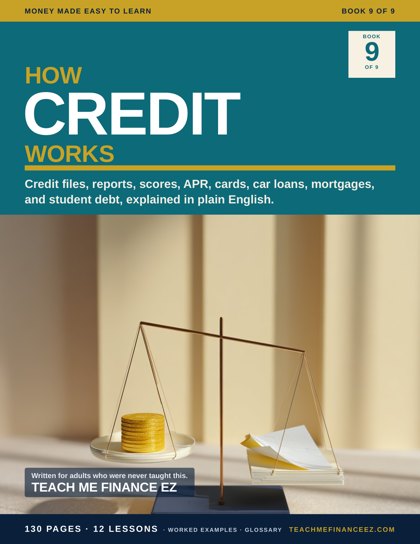
The course teaches it simple: short lessons, a family handout for each, one action at a time. The book is the expanded edition of those handouts — the same material worked to the penny, three different ways, every chapter in one easy place. Own both for the full complement: watch it work here, read it deep on paper.

Credit files, reports, scores, APR, cards, car loans, mortgages, and student debt, explained in plain English.
Digital edition · $19Paperback on Amazon · $34.99So you always know where you are, and the depth never depends on how motivated you felt that day.
A short lesson that names the thing and shows you the shape of it. Lazy-loaded, so the page is not carrying it until you press play.
Five plain sentences, taken from that chapter's own summary, so you can tell in ten seconds whether you already have this one.
A single thing to do on your own numbers. Not a homework pile. One action, small enough that it actually happens.
That lesson's own PDF: the worked example, real blanks for your own numbers, and the one action. Print it, fill it in together, keep it on the fridge.
The exact chapter and page in the expanded book — sold separately — where this lesson is worked out in full, with the math, the three scales, and the six what-ifs.
Mark the lesson complete and the track remembers. Come back next week and it tells you where you stopped.
Every one of these is defined on the page it first appears on, in a sentence a person can actually use.
One file, opened empty and filled in public. The newest track. It is 12 video lessons, each with its own downloadable family handout — a real per-lesson PDF, enough to teach that lesson on its own. Each lesson pairs one video with one handout and one action small enough to actually do. The matching book — How Credit Works — is the expanded edition of those handouts and is sold separately.
Every lesson has its own handout PDF built from that lesson's walk-through: the worked example, the blanks you fill with your own numbers, and the one action. Sufficient on its own — and when you want the full depth, the book works the same material to the penny, in one place.
No — and that is on purpose. The course stands on its own: every lesson has its own family handout PDF, and the handouts are sufficient. The book is the expanded edition — the same material worked to the penny, every chapter in one place — sold separately here as a digital edition and on Amazon in paperback. Each lesson page points you to the exact chapter so the two fit together perfectly. Course plus book is the full complement; the Everything bundle is the one purchase that includes both.
No, and it never pretends to be. Everything here is general financial education. It is not financial advice, not tax advice, not investment advice and not a recommendation about your circumstances. Every dollar figure is an invented practice number for a made-up household — not a forecast, not typical of anything, and not a claim about what anyone earns. For decisions about your own money, a licensed professional who can see your actual paperwork is the right person.
Watch the video, read the chapter, do the one action. Most people give a lesson somewhere between twenty minutes and an hour depending on how much of the chapter they read in one sitting. There is no schedule, no cohort and no expiry — the track sits in your library and waits for you.
It is built in order and the story runs forward, so first time through, in order is easiest. Nothing stops you jumping — every lesson page carries its own family handout and its go-deeper chapter pointer, and your progress is tracked lesson by lesson so you can wander and still know what you have done.
Email us inside 30 days and you get all of it back. No form, no reason needed, and nobody will try to talk you out of it. You may keep the files — asking somebody to delete a PDF is theater.
Yes. The Everything bundle is every book and all seven tracks for $49.99 once, with free updates for life. If you only want this one track, buy this one track — that is cheaper and we would rather you did.
12 lessons, 130 pages of book, 12 printables.
$19.99 once. Every lesson's family handout included. Yours forever, with free updates for life.